
When we are driving our cars, the car becomes an extension of us. If someone threatens to damage our car, we often feel like we have been threatened. While the threat is by proxy, if carried out, the cost of property damage would be very real. Most people have some attachment to their property, beyond mere financial. Other living creatures do not have this type of attachment to objects but rather to other living creatures. We have a tendency to form emotional bonds with inanimate objects and, often, anthropomorphize them. I feel this proclivity to anthropomorphize is the first hint that at some level there is an awareness that our consciousness is a driver in a vehicle that is merely a vessel. There is evidence that consciousness transits from vessel to vessel; that is something I’ll discuss at a future date.
Non-local consciousness is the concept that consciousness is not restricted to a discrete location or physical substrate, such as the brain or nervous system. Instead, it suggests that consciousness might be a basic, all-pervasive force that doesn’t depend on any physical structure. It might connect all living things across different dimensions or realms of space and time.

This theory challenges the conventional, neuroscience materialistic perspective on consciousness as a byproduct of neural activity within the brain and suggests that it could extend beyond the individual, thereby raising questions about the nature of reality and interconnectedness.
Beyond the Brain: Why Non-Local Consciousness Deserves Our Attention
What If the Brain Isn’t the Whole Story?

Neuroscience has given us incredible tools to map the brain. We can inject signals, stimulate regions, and watch neurons fire in real time. But here’s the catch: does that really prove the brain creates consciousness? Or are we just tinkering with the dashboard of a vehicle, mistaking the flashing lights for the driver behind the wheel?
Think about it. If I send voltage into a computer circuit, I’ll get an output. But that doesn’t tell me anything about the software state or the user’s intent. It only shows that the hardware responds. Neuroscience may be making the same mistake—confusing the interface with the origin.
The Case for Non-Local Consciousness
Non-local consciousness flips the script. Instead of assuming awareness is locked inside the skull, it suggests consciousness is a fundamental field—something that exists beyond space and time. The brain? It’s the receiver and transmitter, like a radio tuning into signals.

This perspective explains phenomena that brain-only models struggle with:
- Near-Death Experiences (NDEs): Awareness persists even when measurable brain activity ceases.
- Reincarnation reports: Continuity of consciousness across lifetimes.
- ESP and telepathy: Information transfer without classical signals, reminiscent of quantum entanglement.
A Systems Model of Awareness
Here’s a way to visualize it, using a layered stack:
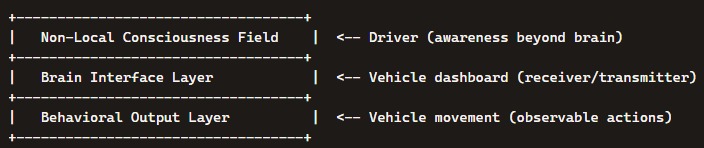
Neuroscience measures the bottom two layers—interface and output. Non-local theories add the top layer, explaining anomalies and subjective experience. Mistaking the interface for the origin is like saying, “The car dashboard generates the driver.”

Why This Matters
If consciousness is non-local, the implications are profound:
- Life and death: Awareness may not end when the brain shuts down.
- Human connection: We may be more deeply interwoven than we realize.
- Science and philosophy: Bridging measurable evidence with lived experience could reshape how we study reality itself.
Closing Thought
Neuroscience has mapped the vehicle. Non-local consciousness asks us to consider the driver. Until science can explain why awareness exists, dismissing non-local theories is premature. Perhaps the most persuasive argument is simple: consciousness feels larger than the brain, and our metaphors should reflect that expansiveness.
 Todays Reality